Elena
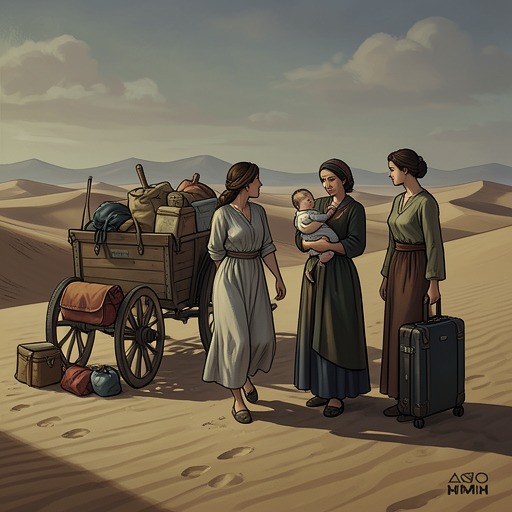
The StaircaseElena is Delvina’s newborn daughter, orphaned by her mother’s death and endangered by the prospect that her violent father might find her. The nuns keep her under watch, but her place in the convent is not settled: when Lizzy begins to imagine taking her to Texas, Elena becomes both a vulnerable child in need of protection and the focus of Lizzy’s emerging, conflicted attachment.
Identity and Circumstances
When Mother Magdalena tells Lizzy that Delvina’s funeral must take place that evening, she explains that Santa Fe requires bodies to be buried within twenty-four hours. The baby will remain in the Bishop’s care, because there appear to be no relatives except a father described as drunken and violent. The convent’s decision gives Elena immediate shelter, but it also makes her safety a practical concern rather than a settled matter of family belonging.
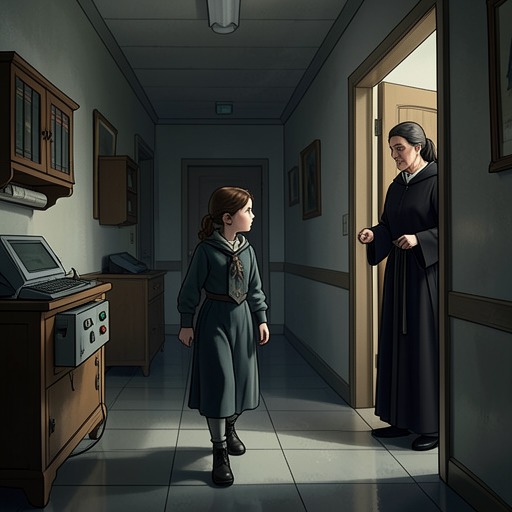
By the time Lizzy enters the church for the funeral Mass, the baby has been christened Elena. The name marks her admission into the community that is assuming responsibility for her, even as her mother’s burial and the absence of other dependable family leave her future uncertain. The Bishop asks for someone to stay behind from the cemetery and mind her; Lizzy volunteers. Teresa Espinosa, the wet nurse the nuns have hired, brings the child out from the church vestibule, and Mother Magdalena hands Elena to Lizzy in the hall.
A Child Seen Through Lizzy’s Care
Lizzy describes Elena’s face as round and lively, and her eyes as seeming to look directly at her, almost as if the baby understood her thoughts. The impression belongs to Lizzy’s perception, not to any speech or deliberate action by Elena. Still, it changes the emotional force of the scene: in Lizzy’s arms, the baby becomes more than a responsibility assigned by the Bishop. Lizzy reads the child’s gaze as encouragement to act, and carries her as a warm assurance while following Mother Magdalena through the candlelit hall.
The convent arranges Elena’s daily care with close supervision. Her cradle is set up in the kitchen, where she can remain in front of someone’s eyes, and Teresa Espinosa is hired to nurse her. Lizzy thinks Teresa probably has a newborn of her own, though the text presents this as her supposition. The arrangement establishes a shared, practical system of care, but Elena receives little attention from the other girls, who are absorbed in their own concerns. Lizzy often picks her up; Ramona tells her that she may help bathe the baby the next day.
Lizzy’s tenderness grows from recognizing Elena’s helplessness and from her own experience of being an only child. She remembers that her classmates in Independence had brothers and sisters, while she had none, and that she often felt responsible for either securing or destroying her parents’ happiness. That history makes the wish for a little sister especially charged: caring for Elena offers the possibility of a sibling bond, but also touches the loneliness and pressure that shaped Lizzy’s childhood.
Attachment and Uncertainty
Lizzy’s feelings do not become simple or certain. After telling José that, if he stayed, she would take Elena with her to live with her father, Lizzy avoids the baby. She doubts her own words and initially explains them as an attempt to persuade José to remain. When she offers again to watch Elena after her last class, she treats the act as a test of whether the promise came from genuine feeling. She insists to herself that she could leave without caring and that the nuns want to keep the child, even as her repeated attention to Elena makes that denial difficult to sustain.
The scene under the garden arbor in early December makes this conflict tangible. Lizzy takes Elena outside in her bundled cradle and sits with her, giving Sister Roberta some free time. The days still have warmth, though the nights are frigid; the small act of tending the baby takes place within that contrast. Lizzy does not resolve her doubts there. Instead, care becomes a way to discover what she feels, while the prospect of leaving Elena behind remains real.
Possible Future and Narrative Significance
Elena’s future becomes part of a larger question of safety. Elinora tells Bishop Jean Baptiste Lamy that Lizzy’s father expects to become foreman of a large Texas ranch, Santa Gertrudis Ranch, and that Lizzy may soon go to live with him. She argues that if Lizzy could bring Elena, the child might grow up in an atmosphere of health and love; if she remains in New Mexico, Ramon Baca may find her. The Bishop asks which ranch, and Lizzy confirms that her father is likely to manage it, as he managed his plantation before the war. The exchange presents Texas as a possible refuge, not an accomplished outcome: permission is still at issue, and Elena’s future is unresolved in the evidence here.
Elena has no spoken part in these decisions. Her presence is conveyed through other people’s choices—being kept after Delvina’s death, watched in the kitchen, held by Lizzy, and considered as a possible member of Lizzy’s future household. That dependence gives the baby a particular narrative weight. Lizzy’s attention turns an assigned duty into an intimate question of kinship, while the threat posed by Ramon Baca prevents affection alone from guaranteeing safety. Elena’s uncertain place thus reveals both the limits of the convent’s protection and the beginnings of Lizzy’s wish to make a family beyond it.